

Ever thought about turning your physical asana practice into a full-time passion? There’s never been a better time: the USA is buzzing with teacher training programs that blend ancient wisdom and modern flair. Imagine guiding a sunrise flow in Central Park, leading an ashram retreat in New Mexico’s desert, or hosting a virtual workshop from your living room—your options are endless.
But here’s the catch: with weekend intensives, two-week immersions, hybrid courses, and fully online streams, choosing the perfect program can feel like trying to pick your favorite pose. The right training doesn’t just hand you a certificate—it shapes your teaching style, deepens your understanding of yoga, and plugs you into a community of fellow yogis.
In this post, we’re diving into everything you need to find the Best Yoga Teacher Training in USA:
- Why the USA stands out for yoga education
- A breakdown of 200-Hour YTT USA, 300-Hour YTT USA, and 500-Hour Hour YTT USA programs
- Unique specialties like Acro, Aerial, and Yoga Therapy
- Tips for matching your goals, budget, and dream location
- Insider advice on Yoga Alliance certification and next-step careers
Ready to discover which path lights up your practice? Let’s roll out the mat and jump in!
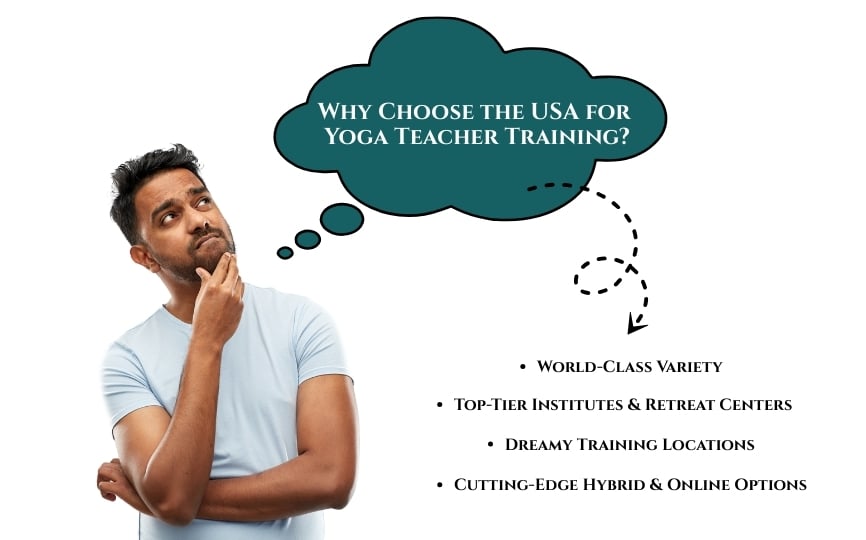
Why Choose the USA for Yoga Teacher Training?
1. World-Class Variety
From coastal California vinyasa flows to strength-building hot yoga in Texas studios, the USA offers an astonishing range of styles under one roof. You won’t be limited to a single lineage—here, you can sample ashtanga, iyengar, kundalini yoga, and more, all taught by some of the most experienced trainers in the world.
2. Top-Tier Institutes & Retreat Centers
Ever thought of learning alignment from a senior teacher, Iyengar NYC, then swapping city lights for mountain tranquility at a New Mexico ashram? The USA is home to prestigious schools, mostly with Yoga Alliance accreditation, that blend rigorous training with comfortable and well-equipped facilities.
3. Dreamy Training Locations
- California: Sunsets on the beach, vineyard yoga weekends, and urban studios in L.A. and San Francisco.
- Hawaii: Lava-view retreats, rainforest shalas, and ocean-front morning meditations.
- New Mexico: Red-rock desert ashrams, starlit sound-healing sessions, and serene art-filled spaces.
Whether you crave ocean breezes, desert stillness, or city energy, you can choose an environment that speaks to your spirit—and fuels your practice.
4. Cutting-Edge Hybrid & Online Options
Busy schedule? No problem. Many US schools offer hybrid formats: foundational lectures online, then hands-on workshops on weekends or during a week-long retreat. You get the flexibility of e-learning plus the expertise of in-person adjustments and community.
Popular Yoga Teacher Training Programs in the USA
a. 200-Hour Yoga Teacher Training
This is the sweet spot for newcomers—and even seasoned practitioners who want a solid foundation.
- What to expect: A mix of anatomy basics, yoga philosophy, teaching methodology, and plenty of hands-on practice.
- Formats:
- Two-week retreat: Wake up to sunrise flows, dive into full-day workshops, then unwind with evening chants.
- Weekend intensives: Perfect if you can only carve out Saturdays and Sundays.
- City-based programs: Evenings or early mornings around your work schedule.
- Why it’s popular: You get your 200-hour certificate (Yoga Alliance–approved!) without quitting your day job.
b. 300-Hour and 500-Hour Advanced Training
Ready to deepen your skills and teach at a higher level? These advanced certifications build on your 200-hour core.
- 300-Hour: Focused on advanced asana alignment, sequencing mastery, and deeper dives into yoga texts.
- 500-Hour: Combines 200- and 300-hour content for a comprehensive, year-long—or intensive two-month—immersion.
- Ideal for: Teachers who want to specialize (therapeutic yoga, yoga for athletes) or lead training themselves.
c. Specialized Yoga Training
Want to double down on one style? Choose from:
- Iyengar Yoga: Precision alignment with props and adjustments.
- Ashtanga Yoga: A set series of vigorous flows to build heat and discipline.
- Bikram Yoga: 26 poses in a heated room—get ready to sweat!
- Hatha & Kundalini: Gentle postures with breathwork or energy-awakening kriyas.
Each style dives deep into its own philosophy, pace, and props—so pick what lights you up.
d. Immersive and Retreat-Based Programs
Craving a total immersion?
- Nature as your studio: Practice sunrise salutations by the ocean, meditate in mountain lodges, or chant under desert skies.
- All-inclusive: Meals, lodging, and workshops bundled together—focus entirely on your growth.
- Community bonding: Late-night heart-circle chats, partner yoga games, and lifelong friendships.
e. Online and Hybrid Yoga Teacher Training
Short on time or far from a studio? Modern programs blend digital convenience with live practice:
- Self-paced video lectures: History, anatomy, and philosophy at your own speed.
- Live virtual labs: Real-time feedback from trainers over Zoom or other online meeting platforms.
- Weekend or week-long in-person modules: Hands-on alignment and community connection.
Unique Yoga Teacher Training Styles in the USA
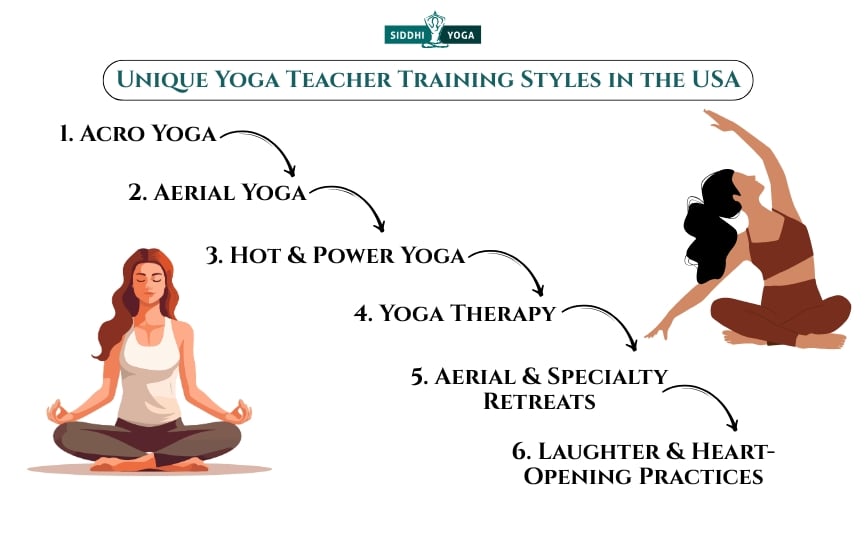
When you want to stand out as a teacher, these specialty trainings can give you that extra edge—each one bringing a fresh twist to the standard curriculum.
1. Acro Yoga
A playful blend of yoga, acrobatics, and Thai massage, Acro Yoga helps you build trust and communication through partner lifts and balances. Great for studios looking to offer community-driven workshops that feel both fun and empowering.
2. Aerial Yoga
Using suspended hammocks, Aerial Yoga allows you to explore inversions and deep stretches with support—perfect for students who are nervous about going upside-down on the mat and for instructors wanting to add a theatrical flair to their classes.
3. Hot & Power Yoga
- Hot Yoga heats up the room (usually around 95–105°F) to help students deepen flexibility, detoxify through sweat, and build mental resilience.
- Power Yoga combines strength-based sequences with dynamic flows—excellent for fitness-focused studios or gyms.
4. Yoga Therapy
This training prepares you to design safe, effective practices for people recovering from injuries, managing chronic pain, or dealing with stress. You’ll learn anatomy-informed modifications and therapeutic sequencing—ideal if you aim to teach in rehab centers or wellness clinics.
5. Aerial & Specialty Retreats
Imagine practicing restorative sequences in a Hawaiian garden or guiding sunrise flows in a desert ashram. Retreat-based formats let you immerse your students in nature, combining traditional asana with local healing rituals—an unforgettable way to deepen both practice and connection.
6. Laughter & Heart-Opening Practices
- Laughter Yoga uses guided laughter exercises to instantly boost mood and break down barriers—fantastic for corporate events or community gatherings.
- Tantra-Inspired Workshops focus on mantra, breath, and partner rituals to cultivate presence and connection—perfect for intimate retreats or advanced teacher trainings.
Finding the Right Yoga Teacher Training Program
Choosing the “best yoga teacher training programs in USA” isn’t just about location or price—it’s about what will truly ignite your passion and fit your life. Here’s how to zero in on the perfect match:
- Clarify Your Goal
- Do you want a fast-track certificate to start teaching ASAP, or a deeper dive into philosophy and anatomy?
- Thinking of leading retreats one day? Look for programs with a strong focus on sequencing and workshop design.
- Pick Your Style
- Craving structure and props? An Iyengar-focused course might be your jam.
- Love dynamic flows and heat? Power or Hot Yoga trainings could be a better fit.
- Leaning toward healing and rehab work? Yoga Therapy or Trauma-Informed modules will equip you with the right tools.
- Weigh Duration & Intensity
- Short & Sweet: Two-week intensives or weekend immersions give you that certificate quickly—but expect long days of training.
- Slow & Steady: Year-long weekend programs spread the learning out, ideal if you have work or family commitments.
- Consider Delivery Format
- In-Person: Maximum hands-on corrections and community bonding—great if you learn best face-to-face.
- Online/Hybrid: Flexibility to study theory from anywhere, with optional in-person labs for alignment practice.
- Check Accreditation
- Look for Yoga Alliance–registered programs if you want global recognition.
- Some schools also carry specialty certifications (e.g., IAYT for Yoga Therapy) that boost your credibility.
- Read Reviews & Talk to Graduates
- Scan social media groups or studio noticeboards—real students share honest feedback on workload, teacher quality, and vibe.
- Reach out directly: most programs are happy to connect you with alumni.
- Balance Budget & Value
- Factor in tuition, housing, meals, and travel.
- Sometimes a slightly higher fee means smaller class sizes and more personal attention—which can be priceless when you’re learning to teach.
You can use these pointers to map out your options, then compare a few programs side by side. Before you know it, you’ll be saying “Yes!” to the one that feels just right for your journey.
Budget-Friendly Yoga Teacher Training Options
Sticking to a budget doesn’t mean compromising on quality. Here are five flexible strategies — each backed by widespread studio practices — to help you secure a top-notch certification without draining your savings:
- Sliding-Scale & Income-Based Tuition
- Many community-focused training programs reserve a handful of seats priced on an income bracket system.
- Trainees apply via a simple form, indicating their financial need; accepted applicants pay a reduced rate while others cover the standard fee, keeping the program accessible for all.
- Many community-focused training programs reserve a handful of seats priced on an income bracket system.
- Work-Trade & Apprenticeship Exchanges
- Swap studio duties (front-desk support, prop setup, light cleaning, or event prep) for partial or full tuition credits.
- Typical agreements range from 3–6 hours of work per week for a 20–50% discount, up to 10–15 hours for a full tuition waiver in longer programs.
- Always confirm the exact hours-for-credit ratio in writing before you commit.
- Swap studio duties (front-desk support, prop setup, light cleaning, or event prep) for partial or full tuition credits.
- Early-Bird & Off-Season Discounts
- Signing up well before a program’s start date often unlocks “early-bird” pricing that can be 15–30% below the regular rate.
- Similarly, choosing sessions in shoulder seasons—late spring or early fall—can trigger off-peak discounts during lower enrollment periods.
- Signing up well before a program’s start date often unlocks “early-bird” pricing that can be 15–30% below the regular rate.
- Online & Hybrid Training Models
- Fully virtual theory modules eliminate travel and lodging costs; many schools price these at 30–50% below their in-person counterparts.
- Hybrid formats let you complete lectures and philosophy work online, then attend just one or two weekend retreats for hands-on labs, balancing savings with alignment practice.
- Fully virtual theory modules eliminate travel and lodging costs; many schools price these at 30–50% below their in-person counterparts.
- Small-Town & Emerging Studio Programs
- Studios in non-metropolitan areas often charge 10–25% less than big-city schools while delivering the same core curriculum.
- Look for programs at countryside retreat centers, mountain lodges, or lakeside studios—where local living costs are lower and class sizes tend to be more intimate.
- Studios in non-metropolitan areas often charge 10–25% less than big-city schools while delivering the same core curriculum.
Quick Tip: Combine two or more strategies—apply for a sliding-scale seat and snag an early-bird rate, or enroll in a hybrid program with a work-trade agreement—to maximize your savings. With a bit of research and proactive outreach, you’ll find a high-quality training that aligns with both your aspirations and your budget.
Best Locations for Yoga Teacher Training in the USA
California Coast & Wine Country
Imagine unfurling your mat on a misty Malibu beach, the Pacific breeze cooling you as the sun breaks over the horizon. Later, you swap salty air for rolling vineyards in Ojai, where anatomy deep dives happen beside oak-shaded tables groaning with fresh salads and local pinot. Weekend intensives in Santa Monica keep costs around $1,800–$2,000, while week-long retreats near Napa often include farm-to-fork meals, making it easy to balance practice with pleasure.
Hawaiian Island Escapes
Close your eyes and hear waves lapping beneath a cliff-edge shala on Maui, or feel the ancient energy pulse through a lava-rock studio on the Big Island. Many schools let you breeze through theory online before you land—so once you touch down, it’s all sun salutations, ocean-front pranayama, and traditional lā‘au lapaʻau plant-medicine rituals. These one-week intensives usually run $2,200–$2,500, but the island magic is priceless.
New Mexico Desert & Creative Retreats
Picture star-studded desert skies stretching above your mat in Taos or Santa Fe, where five-week immersions weave morning asana with evening kirtans and crystal-bowl meditations. Between workshops, you stroll adobe-walled streets dotted with art galleries, drum-circle under moonlight, and share homemade enchiladas in community potlucks. All-inclusive packages hover around $2,200, covering lodging, meals, and everything you need to unplug.
New York City & Hudson Valley
If you juggle a 9-to-5 but crave depth, NYC’s loft studios offer evening and weekend 200- or 300-hour modules—think rooftop flows above the skyline or candlelit hatha yoga in Brooklyn brownstones. Then, just an hour north, Hudson Valley retreats invite you to swap subways for scenic river views, rustic cabins, and farm-fresh breakfasts.
In-Person vs. Online Programs: Finding Your Perfect Fit
Choosing between a buzzing studio and your own living room can feel tricky—so let’s break it down in a way that helps you follow your heart (and your schedule) for a life changing experience.
🔹 In-Person Training
Why it clicks:
- Real-time tweaks: An experienced teacher can gently adjust your alignment on the spot, so you learn safer and smarter.
- Built-in community: From shared car rides to post-class smoothies, face-to-face training sparks friendships that last beyond graduation.
- Total immersion: When you step into a studio or retreat center, life’s distractions fade away — and you’re 100% focused on practice, philosophy, and self-discovery.
Things to weigh:
- Time commitment: Pick your training days — weekdays, a weekend, or a full month — and include travel and lodging costs if it’s not nearby.
- Higher upfront costs: Venue fees, meals, and accommodations add up. (Tip: look for work-trade or sliding-scale options to soften the sticker shock.)
🔹 Online & Hybrid Training
Why it works:
- On your timetable: You can stream lectures whenever you like — early mornings, late nights, or lunch breaks — then practice when inspiration strikes.
- Budget-friendly: No commuting, no hotel bills. Many online courses run 30–50% cheaper than their in-person equivalents.
- Global perspectives: You can zoom in with classmates worldwide — swap stories, cultural insights, and fresh tips in every virtual corner.
Things to weigh:
- Self-motivation needed: Without a physical studio, carving out consistent practice time is key.
- Limited touch: To be honest, videos can’t fully replace hands-on assists—so choose programs that include live alignment labs or local meet-ups.
🔹 Best of Both Worlds
Don’t settle for one or the other—blended training gives you:
- Theory at Home: Tackle anatomy, philosophy, and sequencing online at your own pace.
- In-Person Labs: Join weekend or week-long intensives for hands-on adjustments and that electric studio energy.
- Community & Convenience: Build friendships online, then deepen those bonds face-to-face — without relocating your entire life.
Yoga Alliance Certification and Its Importance
Earning your certificate is one thing — making sure it really opens doors is another. Here’s why choosing a Yoga Alliance–registered program matters, and what to look for:
- Global Recognition
- A Yoga Alliance RYT (Registered Yoga Teacher) credential is accepted by studios and retreat centers worldwide—whether you’re teaching in New York, California, or even Costa Rica.
- Quick check: Planning to teach internationally? An RYT helps studios know you’ve met a trusted standard.
- Quality Standards
- Yoga Alliance sets clear curriculum guidelines covering anatomy, teaching methodology, ethics, and philosophy for their RYS (registered yoga school).
- Graduating ensures you’ve hit all the core components — no surprise gaps in your training.
- Networking & Resources
- RYT teachers and approved schools get access to Yoga Alliance’s online directories, continuing-education discounts, and regional events.
- Insider tip: After certification, you can attend their webinars and local meet-ups to keep expanding your teaching skills as well as networks.
- Student Trust
- Prospective trainees often look for “Yoga Alliance 200-hour yoga teacher training USA” when choosing a program they can rely on.
- Displaying the Yoga Alliance logo on your site or business cards instantly boosts credibility.
- Smooth Progression
- If you start with a 200-hour RYT and later pursue a 300- or 500-hour upgrade, credits transfer smoothly—so your credentials grow with you.
Picking a Yoga Alliance–approved course makes sure your training is recognized and gives you confidence and support as you start teaching.
Career Opportunities After Yoga Teacher Training
Your training is only the beginning—it opens the door to many teaching opportunities. Here’s how your RYT certificate can lead to a rewarding career:
1. Studio & Gym Instructor
- Daily Classes: You can lead Vinyasa, Hatha, or Power Yoga sessions in local studios or fitness centers.
- Salary Snapshot: Full-time instructors in the USA typically earn between $40,000–$60,000 per year, while part-timers charge $25–$35 per class.
Pro Tip: Building a loyal student base—through social media or community events—boosts your bookings and income.
2. Retreat Leader & Workshop Facilitator
- Weekend & Destination Retreats: If you are innovative and want to experiment with your yoga sessions, then you can definitely craft immersive experiences — from beachfront sunrise flows to mountain-meditation weekends.
- Earnings Potential: Retreat packages can range from $300–$500 per participant per day, with profits scaling as you add specialty themes (e.g., yoga therapy, sound healing).
3. Corporate Wellness Coach
- On-Site & Virtual Sessions: You can bring yoga, mindfulness breaks, and stress-management workshops to offices and corporate events.
- Compensation: Companies often pay $100–$200 per hour for group classes and workshop facilitation.
Insider Tip: Highlight unique offerings like “desk-stretch” breaks or chair yoga to stand out in the corporate market.
4. Online & Hybrid Yoga Instructor
- Live Streaming & On-Demand Courses: You can teach yoga classes via Zoom or pre-recorded series on other online platforms
- Income Models: You can opt for either subscription-based memberships ($15–$30/month) or pay-per-class options ($5–$15).
- Community Builder: Regular newsletters, free mini-classes, and social media challenges keep your digital students engaged and help you build a solid online presence.
5. Studio Owner & Entrepreneur
- Opening Your Own Space: Once you understand the business side — marketing, scheduling software, and finance — you can launch your own yoga studio in the USA.
- Revenue Streams: You can look for other complementary options like offering drop-in classes, memberships, teacher training programs, retail products (mats, props), and wellness services (massage, Ayurveda consultations).
Final Thoughts
You’re now armed with everything you need to find the best yoga training USA has to offer. The most important step? Take that first one: reach out to programs, ask questions, and secure your spot.
Remember, choosing a yoga teacher training in the USA is more than ticking a box—it’s a commitment to your own self-growth and a promise to your future students. With each sunrise flow, every deep-dive lecture, and all the hands-on adjustments you receive, you’ll deepen your personal practice and emerge as a confident, compassionate teacher.
So grab your mat, set your intention, and dive in. Your journey of transformation—and the community you’ll inspire—starts now. Namaste!