


Becoming a certified yoga teacher might give you an evergreen career that also keeps you fit. On the road to becoming a yoga teacher, the first big dilemma you will face is to choose between online vs in-person yoga training.
With so many programs available, it’s easy to feel unsure about which path is right for you. Both options have their own strengths and weaknesses; it really depends on your lifestyle, way of learning, schedule, goals, and the kind of experience you want.
In this blog, we’ll discuss what each format offers so that you can make a confident, well-informed choice.
What Does Online Yoga Training Look Like?
An online yoga teacher training program is like having the whole yoga school in your living room. No need to pack or travel—just open your laptop, grab your mat, and you’re good to go. Most programs include a mix of pre-recorded videos, live Zoom sessions, reading materials, and assignments that cover both theory and practice.
You can choose a self-paced course (go at your own speed) or a structured one with live group classes. That flexibility is a big bonus—it lets you fit training around work and family responsibilities.
Most online courses offer live sessions, group chats, Q&As, or personal feedback. You might send in videos of your yoga practice and get tips from your instructors. You’ll meet people from all over the world and be a part of a global yoga community.
If you join Siddhi Yoga’s online training, you can be a part of their global community that is spread across more than 125 countries. With 300+ 5-star reviews and 500+ video testimonials, Siddhi Yoga becomes the first choice to be considered for a recognized online yoga teacher training.
Online teacher training gives you the freedom and variety in learning, but it requires self-discipline. You need motivation, a good internet connection, and a quiet space for online learning.
What Happens in In-Person Training?
The in-person yoga teacher training course is all about being fully present in your body and in the space. You’ll train at a yoga studio or retreat center with other students. It’s an immersive experience where you might eat, sleep, and breathe yoga for a few weeks, weekends, or regular hours every week.
Are you wondering about its advantages in the digital era? You learn by doing. Teachers and classmates are right there with you. You get real-time feedback, hands-on adjustments, and support that helps you grow fast. You’ll also practice teaching others face-to-face.
Most programs follow a daily routine—starting with morning meditation, followed by movement, learning sessions, meals, and more practice. It can be intense, but stepping away from your regular life lets you truly focus on yoga.
These programs provide hands-on learning but might take more time and money. They may take place in faraway retreats or closer to home. You will have to travel to the given location on specific days and at specific times to make this format work for you.
Similarities Between Online and In-Person Yoga Teacher Training

Both modes of doing the yoga teacher training courses teach the same syllabus. You will learn the following subjects in your yoga teacher training.
Yoga Philosophy – You’ll study the real meaning of yoga, including the Eight Limbs, the Yoga Sutras, Gherand Samhita, and other yoga texts. It helps you understand why we practice yoga, not just how.
Asana (Postures) – Isn’t asana the first reason you were attracted to yoga? You can learn proper alignment, how to cue poses, give modifications, and build safe, effective class asana sequences.
Pranayama (Breathwork) – Right breathing is important in yoga. You’ll learn different breathing techniques and how they impact your body and mind.
Meditation – You will learn different meditation techniques to calm your mind. So that you build your personal practice and learn how to guide others.
Anatomy & Physiology – This knowledge will help you understand the effects of yogic practices profoundly. You can learn how yoga affects your muscles, joints, breath, and overall well being.
Teaching Methodology – The inclusion of this subject emphasizes the importance of professional yoga certification. If you can effectively transfer your yoga knowledge and experience, you can lead a class, cue clearly, give feedback, and adjust for different students.
The Business of Yoga – Many programs cover how to start teaching yoga and make the most out of it. This includes marketing, building a brand, starting your online yoga classes, or even using social media.
Online vs In-Person Yoga Training: Point by Point
Here’s a side-by-side look at online and in-person yoga teacher training so you can choose what works best for your schedule, budget, and learning style:
| Factor | Online Yoga Training | In-Person Yoga Training |
| Flexibility | Super flexible! You can learn at your own pace, anytime, anywhere. | It has a set schedule. You must commit to their specific dates and times. |
| Location | You need not travel; rather, you can conveniently study from home. | This format requires travel to a studio or retreat location. |
| Learning Style | An online course is great for self-paced learners who have a zeal to learn. | In-person training is ideal for hands-on learners who like live interaction. |
| Community & Interaction | Their class interactions are through online groups, chats, and forums, but it connects you to the entire global community. | The class interactions create a strong group energy, in-person support, and bonding with peers. |
| Personal Attention | In this format, you can get feedback via video or Zoom. | In-person training gives you instant feedback from teachers, live corrections, and adjustments. |
| Cost | These programs are usually more affordable as they do not need travel or stay expenses. | These programs are often more expensive as they include accommodation and travel costs. |
| Experience Level | Online yoga teacher training is good for those who already have a strong self-practice. | Physical training is great for beginners who want step-by-step, guided learning. |
| Structure | You can learn whenever and wherever you want. Some programs offer loose timelines. | These programs follow a clear daily routine. They are structured and immersive. |
| Technology Needs | A reliable internet connection and a quiet space are must-haves for online yoga training. | You just need to show up physically with your mat for in-person yoga training. |
| Certification | Many online yoga teacher training certifications are Yoga Alliance-approved and fully recognized. | Many in-person yoga teacher training certifications are also Yoga Alliance-approved and fully recognized. |
How Do You Decide Which Mode of Yoga Teacher Training is Better For You?
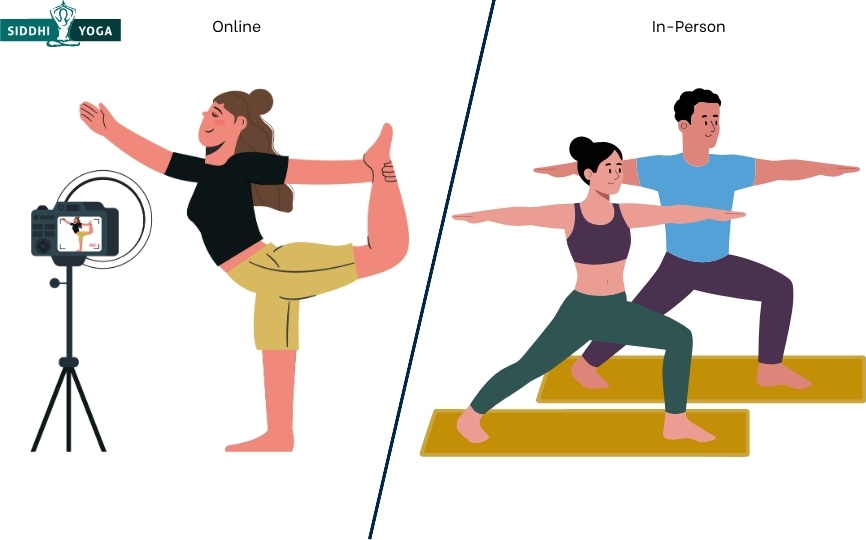
We all learn differently, and that’s totally normal. In the tussle between online vs in-person yoga training, the way you like to learn can help you decide.
If you like to work on your own time, online yoga courses might be for you. You can learn early in the morning, late at night, or whenever suits you. You can pause lessons, rewatch videos, and fit it around work, family, or a busy schedule.
But if you prefer being around people, learning in real time, and getting instant feedback, then in-person training might be better for you.
Still can’t decide? No problem! Some schools offer hybrid options. You attend theory lessons online and join in-person sessions for hands-on practice. It’s a flexible way to enjoy the benefits of both and find what works for you.
Tips to Help You Decide
Need help to solve the battle between online vs in-person yoga training? Here are quick points to ponder and tips to guide you through this decision:
Look at your daily routine
Can you take a few weeks off for full-time in-person training? Or would spreading it out online work better for your lifestyle?
Think about how much support you need
Do you prefer learning on your own with videos and reading, or do you feel more confident with live demonstrations and immediate feedback?
Be honest about your motivation
Online training gives you freedom, but it also takes discipline. If you’re great at keeping yourself on track, it can be a great fit. If not, you might benefit more from the structure of an in-person course.
Read reviews and ask questions
Reach out to former students if you can, or read testimonials and program details carefully. What was their experience like? What did they love (or struggle with)?
Check what’s included
Some trainings come with mentorship calls, teaching opportunities, lifetime access to materials, or even business tips—these extras can make a big difference.
Still thinking about how to become a yoga instructor? At the end of the day, trust your gut. The best program is the one that matches your needs, learning style, and your life’s current age and stage. Yoga is all about listening inward, and that applies here, too.
The Bottom Line
Becoming a certified yoga instructor is a powerful journey of growth, wherever you choose to learn from the comfort of your home or dive into an in-person training.
Online programs offer flexibility and global access, while in-person trainings bring hands-on experience and real-time guidance. Neither of them is better or worse—it all comes down to what fits your life, learning patterns, and goals right now.Don’t overthink online vs in-person yoga training. Take your time, ask questions, and choose what feels right in your heart. After all, yoga begins with connection, and the first connection is with yourself.