


Are you thinking about signing up for a 200-hour yoga teacher training? That’s a big step — and a beautiful one. Whether you’re feeling called to teach or just want to explore yoga more deeply, this kind of training can be a life-changing experience.
But here’s something that often surprises people: not all 200-hour YTTs are the same. The structure might feel similar, but the style of yoga you choose — whether it’s Hatha, Vinyasa, or Multistyle — can really shape how your yoga journey unfolds.
In this blog, I’ll walk you through the three common paths:
- 200-Hour Hatha Yoga Teacher Training
- 200-Hour Vinyasa Yoga Teacher Training
- 200-Hour Multistyle Yoga Teacher Training
We’ll look at what each course offers, how they’re different, and who they’re best suited for — so you can find the path that feels right for you.
First, What is a 200-Hour YTT?
Let’s start simple.
A 200-hour yoga teacher training program, often called a 200-Hour YTT, is a foundational course that helps you go deeper into yoga — not just the poses, but the full picture of what yoga really is. Whether you want to start teaching professionally or just explore traditional yogic practices on a deeper level for yourself, this is where it all starts.
It’s called “200-hour” because the course includes 200 hours of study and practice, as required by the Yoga Alliance standards. If you do it full-time (or in a yoga institute for an immersive class experience), it usually takes about 3 to 6 weeks. But if you’re doing it online or part-time (like weekends or evenings), it might take a couple of months or more — which is great if you’re balancing work or family.
Here’s what you’ll typically learn in a 200-Hr Yoga Teacher Certification:
- How to practice yoga safely – This includes learning how to do poses with correct alignment, understanding your body’s limits, and avoiding injuries.
- How to teach yoga to others – You’ll learn how to guide a class, give instructions clearly, and create sequences that make sense.
- Breathing techniques (Pranayama) – You’ll explore different ways of using your breath to calm the mind, increase energy, or balance your emotions.
- Meditation and relaxation – Simple techniques that help you slow down, stay present, and connect with yourself more deeply.
- Yoga anatomy and alignment – A basic understanding of how the body works in yoga, including muscles, joints, and movement patterns.
- Yogic philosophy and lifestyle – An introduction to the ancient roots of yoga — things like the Yoga Sutras, the concept of balance, non-violence, and mindful living.
- Class planning and sequencing skills – How to put together a full yoga class that flows well, suits different levels, and has a clear intention.
And here’s something many people are happy to hear — you don’t have to be super flexible or advanced to join. You don’t need to know how to do headstands or touch your toes perfectly. What matters most is that you’ve been taking out some time for your personal practice, and now you’re feeling ready to take that next step — to learn, grow, and maybe even share yoga with others.
If you feel that quiet little nudge inside you — that curiosity, that calling — that’s more than enough to begin.
200-Hour Hatha Yoga Teacher Training

Now let’s talk about the 200-hour Hatha YTT, which is one of the most conventional and foundational yoga teacher training certifications out there.
This course is rooted in traditional Hatha Yoga, a style that’s been practiced for centuries. It’s slow-paced, steady, and focused. The main idea in Hatha is to create balance — between strength and flexibility, between effort and ease, and between body and mind.
You learn to hold each posture with awareness, connect it with your breath, and understand how it affects both your body and your energy.
Unlike fast-moving styles, here you take your time. You explore each pose in depth, which helps you build not just physical strength but also mental clarity and emotional grounding.
What this course usually includes:
Teaching methodology and class planning – Whether or not you plan to teach, you’ll learn how to structure a yoga class, how to speak with confidence, and how to create an experience that’s meaningful for students.
A detailed study of classical yoga postures – You’ll learn the foundational yoga poses, their names in Sanskrit and English, and how they benefit the body and mind.
Alignment and adjustment techniques – You’ll understand how to enter, hold, and exit poses safely. You’ll also learn how to help others adjust their postures in a gentle and effective way.
Breathing techniques (Pranayama) – Breathing is a big part of Hatha Yoga. You’ll explore how different breathing practices can calm your mind, energize your body, and balance your nervous system.
Meditation and relaxation – Simple meditation techniques are introduced to help you focus, let go of stress, and become more present in your physical practice and daily life.
Yoga history and philosophy – You’ll dive into texts like the Yoga Sutras of Patanjali to understand where yoga comes from and what it truly means beyond the physical postures.
Who is this course for?
If you prefer a slower, more mindful approach to yoga — this course might feel like home. It’s perfect for people who enjoy taking time with each posture, learning the “why” behind every movement, and creating a strong, steady foundation before jumping into anything fast or flashy.
This training is especially helpful for beginners and also for people who want to go deeper into the authentic yogic practices — learning not just how to do a pose, but how it works within your body, breath, and mind.
If you’re someone who values patience, depth, and the roots of yoga, the 200-hour Hatha YTT might be exactly what you’re looking for.
200-Hour Vinyasa Yoga Teacher Training

The 200-hour Vinyasa Yoga certification is known for being lively, creative, and full of movement. If Hatha Yoga is calm and steady like a still lake, Vinyasa practice is more like a flowing river — constantly moving, yet deeply connected.
This style of training teaches you how to flow from one pose to the next in a way that feels natural and rhythmic, all while staying connected to your breath. It’s often called a “moving meditation” because you’re fully present — body, breath, and mind working together.
The 200-hour Vinyasa YTT takes that energy and channels it into a structured learning experience. It gives you the tools to not only enjoy your own practice but also guide others through meaningful, energetic, and engaging classes.
What you’ll explore in this course:
- How to create flowing sequences – You’ll learn to build classes that move smoothly from warm-up to peak pose and end with relaxation. This includes sequences like Sun Salutations and creative flows built around a theme or goal.
- The art of transitions – You’ll focus on how to move safely and gracefully between poses, keeping your students grounded and injury-free while maintaining the energy of your daily yoga classes.
- Strength, flexibility, and breath awareness – You’ll understand how to develop physical strength and flexibility while also tuning into the breath as a guide and support throughout your self practice.
- Teaching techniques for modern yoga classes – From choosing music and creating class themes to using voice modulation and cues, you’ll learn how to lead Vinyasa classes that feel fresh and inspiring.
Yoga Philosophy and anatomy related to movement – You’ll study how the body moves in a flow, the muscles being used, and how to make your classes safe and inclusive. You’ll also touch on yogic ideas like presence, energy flow (prana), and balance in movement.
Who is this course for?
This course is a great fit if you enjoy movement, variety, and creativity in your yoga practice. If you see yoga not just as poses, but as a way to express yourself through motion… if you love the idea of building your own flows and maybe even using music to set the tone — then this yoga training will feel exciting and inspiring.
It’s perfect for people who want to teach energetic group classes — whether in yoga studios, online, or at a retreat. And even if you’re not planning to teach right away, it’s a great path for anyone who wants to explore yoga in a more dynamic, artistic, and empowering way.
So if you’re someone who loves variety, enjoys a little sweat, and feels most connected when moving to the rhythm of breath — the 200-hour Vinyasa YTT might be exactly what your yogic life is calling for.
200-Hour Multistyle Yoga Teacher Training

Not sure which yoga alliance certification to enroll into? You’re not alone — and that’s exactly where the 200-hour Multistyle Yoga Teacher Training (YTT) comes in.
This course is designed for people who are curious, open-minded, and still figuring out what style of yoga truly speaks to them. It gives you a chance to explore multiple traditions, so you’re not locked into just one approach.
Most multistyle YTTs include a thoughtful combination of Hatha Yoga, Vinyasa Yoga, and sometimes Yin or Restorative Yoga — offering both movement and stillness, tradition and creativity.
The idea behind this course is to give you a broad, well-balanced foundation, so whether you want to become a versatile teacher or just experience yoga from different angles, you feel confident and well-prepared.
What to expect from this course:
- Learning multiple yoga styles and how they differ – You’ll understand the unique features of Hatha, Vinyasa, and other gentle forms like Yin. Each style has its own pace, intention, and energy, and you’ll learn how to work with all of them.
- Practicing both static (Hatha) and flowing (Vinyasa) yoga – You’ll experience holding poses with attention to detail, as well as moving through sequences with breath and flow. This helps you build both stability and flexibility in your practice.
- Introduction to slower, deeper practices like Yin Yoga – These calming, meditative styles focus on long-held postures, deep tissue release, and emotional balance. They’re perfect for winding down, and they teach you how to work with subtle energy.
- Building a strong base in teaching methodology – You’ll learn how to plan and deliver yoga classes in different styles, create sequences, adjust students safely, and develop your teaching voice.
- Understanding how to adapt your teaching for different people – Not every student moves the same way or needs the same thing. This course helps you become a certified yoga teacher who can work with beginners, seniors, athletes, or anyone in between.
Who is this course for?
If you want a well-rounded and flexible understanding of yoga, this training is a great place to begin. It’s especially helpful if you’re not yet sure whether you lean more toward calm and structured practices like Hatha, or creative and flowing styles like Vinyasa.
It’s also an excellent choice if you plan to teach in the future and want to be able to guide different types of classes — from a slow evening stretch to an energizing morning flow. By the end of this training, you’ll have the skills to confidently adapt your teaching to suit various students and situations.So if you’re someone who enjoys learning from different perspectives and wants a full-spectrum yoga experience, the 200-hour Multistyle YTT could be the perfect fit for your journey.
Comparing the Three: Hatha vs. Vinyasa vs. Multistyle YTT
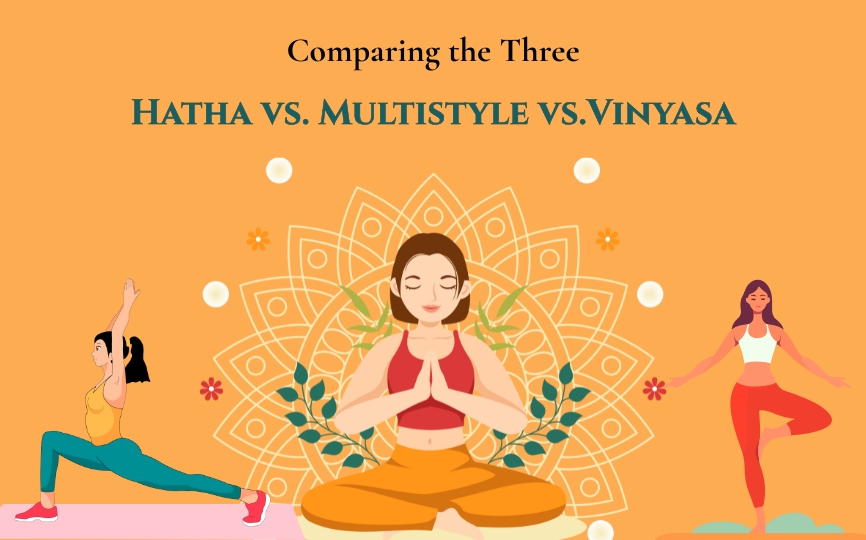
Still wondering which yoga education path feels right for you? Let’s put the three styles side by side, so it’s easier to see what each one offers and how they differ. This way, you can make a choice that matches your personal style, energy, and yoga teaching goals.
| Aspect | 200-Hour Hatha YTT | 200-Hour Vinyasa YTT | 200-Hour Multistyle YTT |
| Style of Practice | Slow, steady, and structured | Fast-paced, flowing, creative | A mix of Hatha, Vinyasa, and often Yin/Restorative |
| Focus | Alignment, breath, and stillness | Breath-to-movement flow, rhythm, strength | Variety, versatility, and exploration of styles |
| Energy Level | Calm and grounding | Energetic and dynamic | Balanced — a bit of everything |
| Good for Beginners? | Yes — great for building strong foundations | Best with some prior practice or fitness level | Yes — especially for those still exploring |
| Philosophy Approach | Traditional yogic philosophy | Modern and experiential, with yogic roots | Combination of classical and contemporary views |
| Teaching Outcome | Great for traditional/classical yoga classes | Great for modern group or studio classes | Great for adaptable, multi-style teaching |
| Who It’s Best For | Those who love depth, tradition, and structure | Creative movers who enjoy challenge and variety | Curious learners who want a broad foundation |
So… How Do You Choose?
The best training is the one that truly fits you — your energy, your goals, and your style of practice. Here’s a quick guide to help you decide:
- Do you love slow, thoughtful practice and want to go deep into traditional yoga? → Go for the 200-Hour Hatha YTT
- Do you enjoy fast, flowing movements and creative classes? → Choose the 200-Hour Vinyasa YTT
- Still unsure, or want to try everything before deciding? → Pick the 200-Hour Multistyle YTT
Whatever you pick, let it come from your heart. Yoga is a journey inward — toward awareness, growth, and connection with your true self.
Final Thoughts
Choosing to do a 200-hour yoga instructor training isn’t just about learning how to teach yoga — it’s about choosing yourself.
It’s about creating space to grow, to listen to your body and mind more deeply, and to step into a version of yourself that’s more aware, balanced, and connected.
Whether you’re drawn to the stillness of Hatha, the creativity of Vinyasa, or the variety of Multistyle, just know that there’s no one right path — only the one that feels right for you.
So take your time. Breathe. Reflect.
And when you’re ready, know that your journey is waiting — and we’ll be right here to walk with you.
Namaste 🙏
A Note from Team Siddhi Yoga
We know that choosing a yoga teacher training course can feel like a big decision — and it is. That’s why, Siddhi Yoga, a YA registered yoga school, offers all three 200-hour YTT options:
Hatha, Vinyasa, and Multistyle — so you can choose the path that truly speaks to you.
Each of our courses is taught by experienced, compassionate and certified yoga instructors who are deeply rooted in their practice. You’ll be supported every step of the way, with a strong focus on safety, authenticity, and personal growth and unlimited access to course material.
We’re here not just to teach you yoga, but to guide you through a journey that’s meaningful and transformative, with easy and simple payment options.
And if you’re still feeling unsure — that’s completely okay. It’s natural to have questions or doubts before starting something new. You’re always welcome to reach out to us, share what you’re thinking, and get honest, caring guidance.
You don’t have to figure it all out on your own — we’re here for you. And our yoga community of amazing teachers and other aspiring teachers is waiting for you!