



Ever catch yourself rolling out your mat at home and thinking, “What if I could turn this passion into something more?” You’re not alone — and the numbers prove it. The global yoga business surged past $107 billion in 2023 and is on track to nearly double by 2030 at a 9.4% annual growth rate. Here in the U.S., the industry already pulled in $22.2 billion last year and is set to reach almost $40 billion by 2030.
That means studios are popping up in every neighborhood, online yoga classes are booming, and wellness brands can’t get enough certified teachers. In fact, American yoga studios alone accounted for $15 billion of that global tally in 2023, with participation ticking upward — about 15 percent of Americans now indulge in yoga practice regularly.
If you’ve ever wondered whether your love for spreading yoga education could translate into a real career, stick around. In this blog, we’ll discuss how much yoga instructors earn and why now might be the perfect time to step into this growing, in-demand field. Your future students — and your bank account — are waiting.
Yoga Instructor Salary in U.S.

When you dig into U.S. yoga teacher salaries, you’ll find different averages because each data source measures something slightly different. The Bureau of Labor Statistics (BLS) looks at all fitness instructors and puts the “middle” teacher at about $46,180 per year (roughly $22/hr). ZipRecruiter, which pulls from active job listings, reports a higher $69,965 per year, noting that specialized corporate instructors can command around $33.64/hr — well above typical studio rates. Glassdoor’s base pay figure sits in between at about $64,000 annually, with big-city markets like New York City skewing higher and smaller towns pulling the average down.
PayScale adds another layer by surveying actual teachers: they find an average of $28.15/hr (ranging from $15.23 for entry-level up to $62.38 for veterans), which translates into about $30,000–$126,000 per year once you include bonuses and tips. Indeed’s June 2025 data comes in around $89,159 per year (≈$38/hr) because it factors in private lessons, workshops, and corporate gigs alongside studio teaching. In plain terms, most U.S. yoga instructors land somewhere between $45,000 and $75,000 annually, with those who mix in one-on-ones, special events, or company wellness programs often pushing into six-figure territory.
How Much Money Do Yoga Instructors Make – Regional Salaries
Where you teach yoga can make a massive difference in your paycheck. Below, we’ll break down typical income ranges in North America, Europe, Asia, and other regions, using the latest data from reliable sources.
| Country | Hourly Rate | Annual Salary |
| United Kingdom | £16.32 /hr | £33,949 /yr |
| Germany | €20.07 /hr | €41,747 /yr |
| Switzerland | CHF 30.92 /hr | CHF 64,314 /yr |
| France | €17 /hr | €34,633 /yr |
| Spain | €13.94 /hr | €28,997 /yr |
| Greece | €12.92 /hr | €26,875 /yr |
| Italy | €17.45 /hr | €36,290 /yr |
| United States | $22.20 /hr | $46,180 /yr |
| Canada (BC) | CAD $18.08 /hr | CAD $37,602 /yr |
| Australia | AUD $23.00 /hr | AUD $48,480 /yr |
| India | ₹166.10 /hr | ₹345,487 /yr |
| Thailand | ฿105.68 /hr | ฿219,823 /yr |
| Indonesia (Bali) | Rp 96,932 /hr | Rp 201,618,402 /yr |
The pay rates listed here come from ERI SalaryExpert’s 2025 data, double-checked with Indeed, PayScale, Glassdoor, and ZipRecruiter. All figures are rounded to the nearest whole number.
North America

United States
- National Averages:
- BLS (May 2024) reports fitness trainers and instructors (including yoga teachers) earn a median $46,180/year (about $22.20/hr).
- ZipRecruiter (May 2025) lists the average at $69,965 corporate yoga instructors average around $33.64/hr.
- Major City Examples (2025 ZipRecruiter Data) :
- New York, NY: $46/hr
- Brooklyn, NY: $44/hr
- Denver, CO: $40/hr
- Miami Beach, FL: $39/hr
- Austin, TX: $39/hr
- San Diego, CA: $37/hr
- Chicago, IL: $37/hr
- Indianapolis, IN: $36/hr
Canada
- Talent.com (2025) reports the average yoga instructor salary in Canada at $35,149/year (around $18.03/hr). Entry-level instructors start near $10,622/year, while experienced teachers can make up to $68,429/year.
- Glassdoor Canada indicates a median salary of CA$56,974/year; ZipRecruiter’s British Columbia average is CA$31.96/hr (May 2025).
Europe

United Kingdom
- According to Indeed, the average annual pay for yoga instructors in the UK is £50,656 (about £26.97 per hour), depending on location.
- According to Talent.com, the average yoga teacher salary in the United Kingdom is £35,000 per year or £17.95 per hour. Entry-level positions start at £27,500 per year, while most experienced workers make up to £39,413 per year.
- Big cities like London skew toward the higher end (closer to £30), whereas smaller towns or rural studios land near the lower end (£18).
Germany
- ERI SalaryExpert data shows German instructors earning €41,739/yr/year, with Bremen and Aachen at the top end of the range.
- Studio classes typically pay €20–€35/hr, while workshop and corporate sessions can fetch €50–€75/hr.
Other European Markets
As per SalaryExpert,
- France: Average yearly pay is around €41,380 per year with the average in Suresnes (€46,771/yr) being 13% above the national norm.
- Spain: Instructors often earn annual average salaries of €19,024 per year, or €9/hr.
- Nordics (Sweden, Norway): In Sweden, instructors earn $29,647 per year on average and in Norway, instructors earn $29,814 per year, on average.
Asia

India
- Salary ranges for local studio instructors: often under $5,000/year in non-tourist cities; major studios in Mumbai or Delhi may pay $7K–$12K/year.
- Yoga Retreats (e.g., Rishikesh, Goa): Teach weekly retreats for $800–$1,500/week, translating to $20K–$60K/year if you lead 20–30 weeks annually.
- Corporate & Expat Classes: In metro areas, specialized studios targeting expats can pay $20–$40/hr.
Southeast Asia (Bali, Thailand)
- Retreat work: Similar to India—around $800–$2,000/week, depending on the resort’s quality and enrollment.
- Studio Classes: Expect $15–$30/hr, which can yield $10K–$18K/year if teaching regularly.
Japan & South Korea
- In Japan, the national average salary is $19,915 / yr (≈ $9.57 / hr), whereas Tokyo offers salaries above the national average at $27,460 / yr (≈ $13.20 / hr).
- South Korea offers similar salaries to instructors at $20,867 / yr (≈ $10.03 / hr) with Seoul offering more than the national average at $27,779 / yr (≈ $13.36 / hr)
Other Regions
Australia
- Indeed (2025) reports an average hourly rate of $47.55 / hour
- As per PayScale, the average hourly pay for a Yoga Instructor is AU$46.91 in 2025.
Latin America
- Mexico (Cancún, Tulum): Resort-based instructors earn $50–$75/hr, which can translate to $15K–$30K/year if teaching 20–30 weeks.
- Brazil & Argentina: Urban studios in São Paulo or Buenos Aires pay $15–$30/hr; annual salaries hover around $12K–$18K.
Middle East
- Dubai & Abu Dhabi: High-end studios pay $40–$70/hr; annual incomes for full-time instructors can reach $30K–$45K USD.
- Qatar & Kuwait: Expat-focused gyms and corporate wellness programs sometimes offer $50–$80/hr, plus housing stipends.
Africa
- South Africa (Cape Town, Johannesburg): Studio classes average $15–$25/hr, leading to $10K–$20K/year.
- Morocco & Kenya: Retreat work (coastal resorts or safari lodges) pays $500–$1,200/week, but local studio wages are under $10/hr.
Why These Numbers Vary So Widely
Yoga teacher paychecks can swing wildly because local living costs, client types, and your own expertise all play a role—teaching five evening classes in a small town won’t earn the same as leading private corporate sessions in a major city. Add in differences in full-time versus part-time schedules, niche certifications, and market competition, and you’ve got a broad range of possible earnings.
- Cost of Living & Local Budgets
Teaching in New York City—where rent can hit $3,000/month—means studios must charge higher rates (think $30–$50/hr) so they can cover overhead. In Bali, with ~$500 rents, classes run closer to $10–$20/hr, matching what locals can afford and what resort guests will pay. - How Many Hours Do You Teach
If you’re in Sydney logging 40 hours a week, you can pull in around AU$80K a year. But running just five evening classes in a quiet town? You might only make under $10K annually. Bottom line: more booked hours = more income—if you can fill them. - Who’s on Your Mat
Corporate wellness programs at tech firms or banks come with big budgets—expect $200–$400/hr for a midday desk-yoga session. Regular studio drop-ins, by contrast, typically pay $30–$85 per person. Your client mix can literally double (or triple) what you earn. - Specialty Skills & Certifications
Add a therapeutic or prenatal yoga credential, and you can tack on $10–$25 extra per class because students pay for your niche expertise. That bump turns a $60/hr session into an $85/hr specialty workshop—and it sets you apart from “generic” teachers. - Experience & Reputation
A fresh 200-hour grad might start at $15–$25/hr while they build confidence and students. But once you’ve got a 500-hour certification—or a string of five-star reviews—you can command $50–$100/hr (or more in major markets) simply because you bring proven results. - Market Saturation & Studio Competition
In yoga hotspots like Los Angeles or London, dozens of teachers chase the same studios, so rates can dip to stand out. In smaller towns or underserved neighborhoods, you’ll find hungry students and less competition, meaning you can hold firm (or even raise) your prices.
Yoga Instructor Income by Teaching Modality
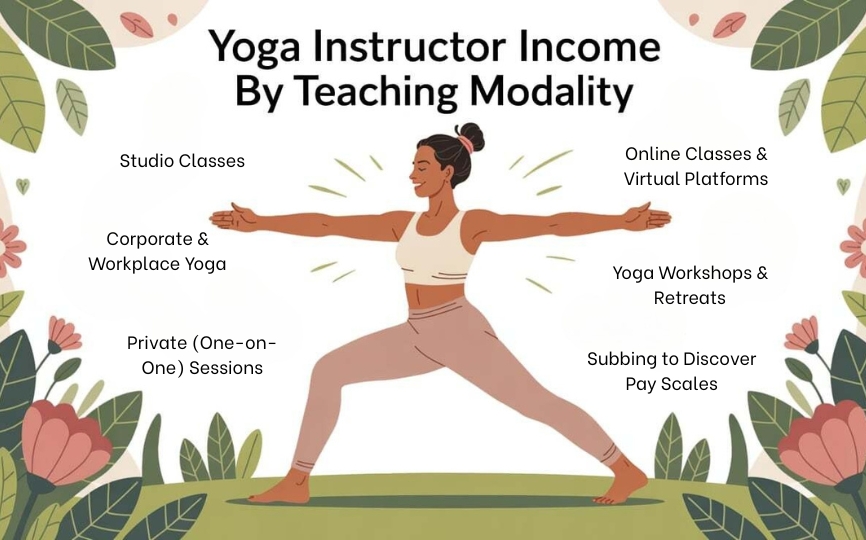
Not all yoga gigs pay the same. Your paycheck can look very different depending on whether you’re leading a studio flow, rocking a corporate chair pose session, or streaming classes online. Let’s break down the most common ways to earn — and how much you can expect.
1. Studio Classes (Group Sessions)
- Typical Rates: Most studios pay $30–$85 per class, depending on the city and studio reputation. For example, Indeed data shows some Maryland studios offering an average salary of $48.28 per class, while Texas instructors average $39.98 per hour for a group class.
- Employed vs. Contract:
- Employed: You might receive a flat hourly wage (e.g., $20–$30/hr) plus extra benefits by the employer — rare in yoga, but sometimes available at big fitness chains.
- Contract: More common — studios pay you a flat fee per class (e.g., $40/class) or a percentage of drop-in fees (often 50%).
- Consistency vs. Flexibility: Studios often expect availability during peak hours (early mornings, evenings, weekends). You can earn better, but at the cost of more late-night and early-bird wakeups.
2. Corporate & Workplace Yoga
- Average Pay: ZipRecruiter data shows the average corporate yoga instructor makes around $33.64 per hour in the U.S.. Rates vary by region — for instance, in Ohio, corporate teachers earn about $31.98/hr, while Bronx, NY instructors pocket $35.04/hr on average.
- Why It Pays More: Companies often include extra prep time, travel, and liability insurance. Plus, corporate clients want a polished experience — so they pay a premium compared to a drop-in studio class.
- Booking Volume: If you teach two 1-hour lunchtime sessions at $35 each, that’s $70/day. Work twice a week for a month, and you’ve made $560 — all while wearing business-casual leggings.
3. Private (One-on-One) Sessions
- Typical Range: Private sessions are your highest-paying bread and butter—anywhere from $60 to $150+ per hour. PayScale reports the U.S. average around $28.15/hr for general yoga teaching, but private rates often double or triple that.
- Who Pays More? High-end wellness clients (e.g., executives, celebrities) often pay $100–$150/hr for personalized sessions. Even a beginner client willing to pay $75/hr is a solid bump on top of group-class income.
- Scheduling & Commitment: You’ll need to market yourself — build trust, gather testimonials, and show results. Once you lock in 5 weekly private clients at $75 each, that’s $375/week (about $1,500/month) just from one-on-one work.
4. Online Classes & Virtual Platforms
- Livestream Sessions: Platforms like Zoom or a studio’s membership portal pay anywhere from $5 to $25 per live attendee.
- Pre-Recorded Content: On sites like Udemy, Teachable, or your own membership page, prices range $10–$50 per course. If you sell 100 copies of a $20 course in a month, that’s $2,000—minus the platform’s percentage cut.
- Subscription Models: Monthly streaming subscriptions (e.g., $10/month) can yield $5–$7 per subscriber after platform fees. With 200 subscribers, that’s around $1,000–$1,400/month passive income once content is up.
5. Yoga Workshops & Retreats
- Weekend Workshops: Charging $75–$150 per participant for a 3-hour workshop is common. If 20 people attend at $100 each, that’s $2,000 for one afternoon — minus venue costs.
- Destination Retreats: Retreat centers (Bali, Costa Rica, Rishikesh) often pay instructors $800–$1,500 per week.
6. Subbing to Discover Pay Scales
- Why “Subbing” Helps: Substitute teaching at studios is like a secret income hack — you fill in for someone else’s class and usually get a slightly higher rate. Most studios pay sub teachers $35–$55 per class, depending on demand.
- Insider Info: By subbing, you learn which studios pay top dollar, which time slots are most lucrative, and which class styles draw bigger crowds. You might discover a studio that pays $60/class for evening flows, even though their standard instructors get $45.
Factors That Influence Your Paycheck

Your yoga income isn’t just “number of classes × rate” — it’s shaped by a blend of elements that determine what you can charge and how often students book. Here’s what really moves the needle:
- Experience & Certification
Just out of a 200-hour yoga teacher training? You’ll typically start around $20–$30/hr in studios. Earn your 500-hour certificate — or add a specialty like prenatal or therapeutic yoga — and suddenly you’re in the $40–$60/hr club (or even $10–$25 extra for niche workshops). - Location & Cost of Living
Teaching in New York City, where rent can top $3,000/month? Studios expect to pay $50–$85 per class. Head to a smaller town, and that same class might be $20–$35. And if you lead retreats in Bali or Cancun, you could pull in $800–$2,000 for a week of sun salutations. - Your Teaching Style & Niche
Vinyasa yoga and Ashtanga flows are always in demand — think $50–$75/hr in big cities. Love the heat? Hot yoga and aerial sessions fetch a 20% premium ($60–$90/hr). Got corporate or therapeutic chops? You’re looking at $80–$120/hr for those specialized gigs. Being a children’s yoga or pilates instructor may fetch you even more dollars per hour. - When You Teach
Early-bird (6–9 AM) and prime-time evening slots (5–8 PM) are gold — studios often tack on an extra $5–$10/class. Midday classes (11 AM–2 PM) tend to pay $25–$35, and weekend workshops (hello, “Brunch & Flow”) can command top dollar. - Studio Reputation & Connections
Big-name studios with packed rosters generally pay more. But jumping into a new studio early can build loyalty — and more classes — for you. Plus, teaming up with popular instructors or local wellness events often opens doors to higher-paying guest spots. - Marketing & Self-Branding
Got a solid Instagram or YouTube following? You can add $10–$20 to your private-session rates just on social proof. Pair that with a clean website and an email list — sending weekly tips and early-bird deals — and you’ll fill your classes faster and confidently raise your prices.
Additional Income Streams for Yoga Teachers
You don’t need a huge following or fancy products or ,extremely fulfilling yoga career to boost your earnings. Here are four simple, doable ideas that fit neatly around your regular teaching classes and are irrelevant to how many students you teach:
1. Mini E-Guides
Package a short, themed sequence — like a “5-Minute Morning Wake-Up Flow” — into a downloadable PDF. Price it at $5–$10, share it with your current students, and watch small sales add up. It only takes a few hours to create and then earns money anytime someone downloads it.
2. Affiliate Recommendations
Choose one or two yoga props you genuinely love—say, a non-slip mat or a comfy strap—and share honest reviews via your newsletter or social stories. When your yoga students click your link and buy, you get a 5–10% commission. It’s effortless income on gear you already use.
3. Themed Mini-Workshops
Host a single 90-minute session at your studio or local community center—think “Desk Yoga for Office Workers” or “Full Moon Restorative Stretch.” Charge $20–$30 per person, require just basic props, and fill a small class of 10–15 students. One workshop can bring in $200–$450 in an afternoon.
4. Online Drop-In Classes
Set up a weekly 45-minute Zoom class at $10–$15 per drop-in. You only need a free Zoom account and a simple booking page. Just ten students a week adds $100–$150 to your income, and you reach people who can’t make it to your in-person sessions.
Start with one or two of these, see what resonates, and gradually build your side income—no overwhelm required!
Actionable Tips to Boost Earnings
Ready to level up your earning potential? Here are practical steps you can take—starting today—to see that paycheck grow, without losing your zen.
Set Smart Rates
Calculate your true hourly value by factoring in prep time, travel, and taxes. If you want $50/hr after expenses, charge at least $70–$80/hr. Raising rates in small increments—say $2–$5 every six months—keeps your pay competitive without shocking students.
Bundle Your Services
Create simple packages like “5 Group Classes + 1 Private” or “3 Workshops + E-Guide.” Bundles deliver value to students and lock in more income up front, smoothing out slow weeks in your regular schedule.
Host a Mini-Series
Instead of a one-off workshop, run a three-week “Core Strength Flow” or “Full Moon Restorative” series. Students commit to multiple dates, guaranteeing you attendees and giving you steadier revenue over several weeks.
Leverage Local Partnerships
Team up with a coffee shop, bookstore, or co-working space for pop-up classes. Hosts often promote your event to their customers, filling spots faster, and you may even teach for free space and a share of proceeds.
Grow Your Email List
Offer a free “7-Day Desk-Yoga Challenge” PDF in exchange for a sign-up. Send one weekly tip and a soft invite to your paid offerings. Email marketing turns casual browsers into loyal, paying students over time.
Track & Optimize
At month’s end, review which classes, privates, or workshops brought in the most revenue. Double down on your highest-earning formats, tweak or drop underperformers, and set clear income goals for the next month.
Timeline to Financial Success as a Yoga Instructor
Most people who search “How much do yoga instructors make?” aren’t just curious about numbers — they’re really wondering: “When will I actually start making a decent income?”
This section breaks down a realistic timeline that shows how yoga instructors typically grow financially — from teaching their first class to potentially earning a full-time income. If you’re planning to shift careers or invest in yoga teacher training, then this is a must – know for you.
0–6 Months: Foundation Phase
- Typical Income: $0–$500/month
In the early months, most new instructors are focused on gaining teaching experience. You might start by offering free community classes, teaching friends and family, or subbing at local studios.
Don’t expect much income yet — this is the time to build confidence, learn how to manage a class and start growing your network. Many teachers also work part-time elsewhere during this period.
6–12 Months: Getting Your Foot in the Door
- Typical Income: $500–$1,500/month
By now you’re teaching more consistently — perhaps 2 to 5 classes a week at studios, gyms or online. You might start attracting a few private clients or getting paid for workshops.
Income is still modest but you’re getting your name out there and starting to figure out what types of teaching (vinyasa, restorative, corporate yoga, etc.) suit you best.
1–2 Years: Building Consistency and Recognition
- Typical Income: $1,500–$3,000/month
With a year or more of teaching under your belt you’re likely offering regular classes, building relationships with students and getting referrals.
You may also branch out — teaching private sessions, hosting workshops or offering short courses. Income becomes more stable and you start to see the results of your efforts.
2–3 Years: Full-Time Potential
- Typical Income: $3,000–$5,000/month
At this stage many instructors can go full-time if they want to. You might have a loyal following, a full teaching schedule and multiple income streams — studio classes, private clients, corporate yoga or online offerings.
You’ve also refined your niche and teaching voice which allows you to charge more and work more efficiently.
3+ Years: Expanding and Scaling
- Typical Income: $5,000–$10,000+/month
Once you’re three or more years in, opportunities open up to scale your income. Experienced instructors run retreats, sell online courses, lead teacher trainings or open their own studios.
You may also start earning passive income from digital products or memberships which gives you more flexibility and financial freedom.
Why This Timeline Matters
Salary numbers alone don’t tell the whole story. This timeline gives you a clear, honest view of the journey ahead — from getting started to building a sustainable, fulfilling career as a yoga instructor.
It helps you set expectations, plan your transition wisely and see the long-term potential of this path.
Common Challenges & How to Overcome Them
Even the most seasoned yoga instructors face hiccups — let’s tackle the big ones so you can keep your practice (and your paycheck) on track.
- Inconsistent Income
- The issue: One month you’re booked solid; the next you’re scrambling for clients.
- The fix: Maintain at least two revenue streams — group plus private classes or workshops—and build a small buffer (save 20% of each month’s earnings). That way, slow weeks don’t derail your budget.
- Burnout & Overwhelm
- The issue: You love teaching, but non-stop classes leave you drained.
- The fix: Schedule one full rest day every week. Block “office hours” for admin and lesson prep. When you protect downtime, you teach with more energy and enthusiasm.
- Pricing Yourself Too Low
- The issue: You undercharge and feel resentful when other yoga instructors earn more.
- The fix: Survey local rates, calculate your true cost of doing business (travel, taxes, prep) and raise your rates in small steps—$2–$5 per class every few months. Communicate the value you bring (expertise, niche expertise) so students understand the increase.
- Marketing Paralysis
- The issue: You know you should promote yourself but don’t know where to start.
- The fix: Commit to one simple action each week—post a student testimonial, send a short email update, or share a quick tip on social media. Consistent, small steps build momentum and visibility over time.
- The issue: You know you should promote yourself but don’t know where to start.
- Tech & Booking Headaches
- The issue: Juggling calendars, payment links, and video calls can feel chaotic.
- The fix: Pick one all-in-one scheduling tool (e.g., Acuity, Calendly) and use it for every class or private. Link your payment processor (Stripe/PayPal) once, and you simplify bookings, reminders, and invoices in one place.
- The issue: Juggling calendars, payment links, and video calls can feel chaotic.
- Student Retention
- The issue: New faces drop off after one or two classes.
- The fix: Invite attendees to join your email list with a small freebie (e.g., “3-Poses-for-Lower-Back-Pain PDF”). Send monthly newsletters with class highlights and upcoming events. A personal “thank you” message after their first class goes a long way toward building loyalty.
- The issue: New faces drop off after one or two classes.
Every yoga instructor faces these bumps on the road: unpredictable income, burnout risk, marketing jitters, and tax headaches. By building multiple income streams, setting boundaries, sharing authentic stories, and staying organized financially, you’ll not only survive — but thrive — as a yoga teacher.
Final Thoughts
Your income as a yoga instructor depends on your location, credentials, teaching style, and willingness to diversify. By combining studio classes, private sessions, digital products, workshops, and retreats — while investing in targeted certifications—you can build a stable, thriving career. Keep exploring new avenues (like “subbing” to learn local pay rates), market your unique expertise, and stay organized financially.
With this roadmap, you’re equipped to turn your love for yoga into a sustainable livelihood—balanced in both soul and bank account. Namaste to that!
Check out our other post: